Beyond the Women's Building

Women Architects and World Fairs

Page 3 of 4

First Phase of the Mapping Project is Complete!

Well, this is a little late, but October is the crazy middle of any semester, with too much to do between grading two writing assignments and evaluating the first phase of student work on the mapping of modernist architects. And technology taketh away even as it giveth: an external hard drive with all of my teaching materials (7 years of syllabi, lectures, powerpoints, images, film files) died, kind of came back to life for a week to allow me to rescue material one file at a time, and then died again for good. In case you are immediately asking, what about the backup? I did have a backup, but it also failed (I got a message telling me “unspecified errors” were preventing me from accessing the backup, which was so. not. helpful.). But the data (literally) is in on the mapping project–what have I and the students learned?

1. Even with very specific written instructions (reiteration of what was also communicated in class during the technology day), students will ignore instructions and do their own thing. I had so much variety in the pins, labels, additional description/text/video materials from students. Some students just placed a pin on the map, without adding architect and date information, or images, article links and videos to supplement their pins as had been requested in the assignment. Some students, on the other hand, gave me an abundance of links, long descriptions, and some students even tried to take up the idiosyncratic challenge of finding a video to relate to each of their pins for a built work on the map. On the plus side, everyone did place pins for most of the built works in their assigned section of the textbook–no abstentions, and no students who missed pinning more than one or two built works (one student jumped over Switzerland in his textbook section and then showed me his used textbook with those pages missing–now, he could have torn them out himself, and he also could have looked at the actual page numbers to realize he was missing something, but it was an anomaly among his otherwise complete pins for the rest of his section). Using technology in pedagogy doesn’t substantially change the instructor’s ability to see clearly who is doing A+ work and who is doing C- work.

2. The students weren’t yet thinking of the project as a whole beyond the pins for their sections of the textbook. During the class discussion where we evaluated the whole map together, students did not seem to have any new insight into modern architecture when seeing it represented geographically in total. This was a disappointment for me because I thought that seeing the huge gaps in geographic representation (almost none of Africa south of the Mediterranean fringe, none of China–or Canada for that matter–with pins) would start discussion about possible textbook bias and/or the problematic first world origins of “modernism,” its definition and its global spread. My students don’t have a very good grasp of global history in general, and I am uncertain about how much of this I have to incorporate into an art history course just to give them the proper context in which to see modernism as a broader concept but also as a specific architectural and cultural agenda of the 20th century.

3. Based on a small sampling of individual student feedback (from students who actually talk to me outside of class), they liked doing the mapping itself. One student is using the new skill to create a map in an Islamic art class, where he will map Andalusian Caliphal architects, which his instructor is also enthusiastic about. This did make me realize that I need to ask for student feedback in general on the project as we go along, rather than wait for it to come out at the end of the semester in course evaluations.

Student teams of 3 have already started adding pins for the second phase of the mapping project, mapping built works by women architects. Using the Virginia Tech International Archive of Women in Architecture as a starting point for research, each team will be mapping at least 15 built works for a given date range and with the proviso to have at least 3 different women architects represented among those fifteen (especially didn’t want to see the last decade plus become the “Zaha Hadid” years, when there should be more female architects than ever to choose from). To increase the in-class assessment of the pinning exercise, each team will be giving a lightning presentation of their research results on this portion to their peers during the final exam period.
The Perils and Pitfalls of Group Online Work in Google Maps Beta

As promised, this Digital Art History Thursdays post is about the progress that has been made in my Modern Architecture course in using Google Map Engine Lite (now out of beta and officially My Maps) to create a group map. Phase one of the project will be finished in mid-October, but the following issues arose as we got started:

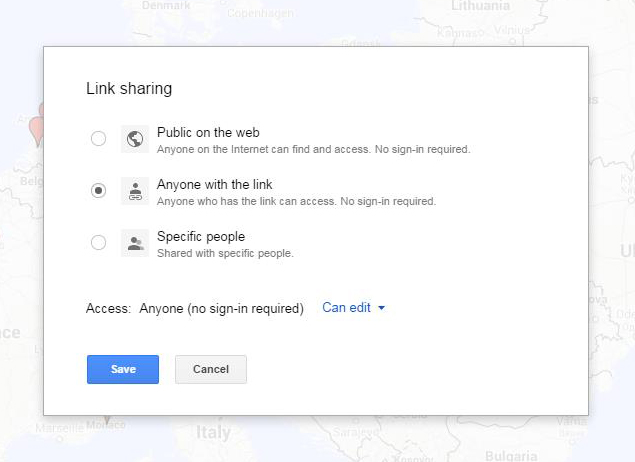
1. Google, in various ways, provides incorrect information about how to share maps in such a way that all users could edit the map. Below are the options that Google gives you for sharing maps.

Google Map Sharing

Since our map was for class purposes, and would likely have some bumps along the way, option 1 was discarded immediately. The class will vote at the end of the semester about whether to make the final map public or not. In theory, I could have used option 3 to share with all of the students in the course by entering their individual email addresses into a list and letting them access the map by signing into Google, but this too was discarded as an option because Google rejected their university email addresses out of hand (and one at a time also–I would delete an email from the list and Google would reject another, and so on) and because the task of collecting everyone’s gmail address (and because some students did not have gmail addresses, which I did not want to force them to create) would have made the sharing process too piecemeal and drawn out instead of giving everyone equal access from the first day. So I chose option 2 and emailed the map link to all of the students via the course Sakai page–they could bookmark the link and Google (supposedly) wouldn’t care what email address they had or even who they were when they accessed and edited the map. Easy, right?

But then a student tried to access the map, and this is where things were clearly not as advertised. Notice above that option 2 says “no sign-in required” and that the access level is “Can edit.” My student could view the map, and could even see a red Edit button in the top right corner of the map toolbar on the left side of the map. However, clicking the Edit button resulted in nothing. Searching for a place in the map search bar would drop a green pin on the location, but that green pin could not be grabbed and added to the map. The student could, in actuality, not edit the map. Nowhere in the Google support documentation does it indicate that sharing maps requires signing in to Google before one can edit a map, but that is the truth that several independent help forums had conclusively discovered. Every student, even the ones who had not previously had gmail or Google accounts, had to now sign in to Google to be able to edit the map.

So Google lied. But it was more like they lied out of ignorance about how their own tool was supposed to work than to deliberately obfuscate. In theory, maps work like docs on Google Drive. In practice, Google’s My Maps can be viewed by strangers (to Google) but only edited by friends (of Google). Something to consider when looking for a more open tool for classroom use.

2. We also discovered that, despite the promise of the ability to add data to a map by importing it from an Excel spreadsheet, Google only allows one spreadsheet import per layer of the map. Out of general assignment fairness, I couldn’t allow the first student out of the gate to have this ability and then deny it to everyone else. This required a bit more logistical thinking before coming up with a procedure that could be used by the whole class.

I could have had each student make a layer, and, since I have a Maps Pro account, we would have been able to have that many layers (times 2, because the students would be doing the same thing for the next phase of the project), but this would also have been difficult to read through on the maps toolbar and also open up a lot more room for importing and data entry error (data columns in different orders from layer to layer, less accurate place locations found, etc.).

Or I could have had every student send me their spreadsheet data a few days in advance of the phase one unveiling and then I could have synthesized their data into one sheet and uploaded it to the map. Since part of the goal of the project is to have the students get hands-on with the digital tool, this was an obvious nonstarter.

So, instead of adding data in sets, each student will be adding individual points to the map for their assigned “section” of the project. Already we have seen that the map search bar can find built works at their actual physically specific street address, so the pins will be very accurately placed on the map, without the students having to enter GIS coordinates. The students can still copy and paste prepared data from their spreadsheets (which is the part of the assignment that will be turned in for the actual grade). And they can more directly and easily add images and video directly from the pin editing function using Google search. Since most students will be adding 15-20 pins, taking the route of adding one item at a time is not excessively burdensome as a whole.

For the next blog post, a report on the results of phase one of the mapping project.


Practicing Digital Art History

I spent two weeks this summer participating in Rebuilding the Portfolio, an introductory digital humanities workshop for art historians sponsored by the Getty Foundation and held by the Roy Rosenzweig Center for History and New Media at George Mason University. After two intense weeks that one of my colleagues nicknamed “DH bootcamp,” I returned to work eager to implement some of the things I had learned. So here are some thoughts now that the fall semester has begun and I have time to evaluate where I am in terms of practicing digital art history.

Public Scholarship

Ha! I have been so busy getting my syllabus and sakai site together for my fall course in modern architecture, as well as performing departmental service in the form of updating art.unc.edu to reflect all of our upcoming fall activities, add new faculty members and staff to the website, and post news about everyone else’s busy summers, that I haven’t really found the time to figure out when and how and what public engagement will look like for me. So this is what I have done so far:

  1. I organized my Twitter feed using Tweetdeck, which has been very illuminating and helped me keep the flow of information in some more tidy categories, including #digitalhumanities and #doingdah2014 as well as inspirational tech and GLAM feeds. As a result, I have tweeted and retweeted to keep relevant dah news stories, gained followers, crossposted things that I have discovered from other dh and daher’s to the vrl facebook page (and picked up some more facebook followers too!), and in general feel like I am now a part of the digital humanities conversation on Twitter, where so much important news and information gets shared.
  2. As you can see from the date of the previous blog post compared to this one, I have not been quite so active on my new website. Okay, so for a week my website was suspended by ICANN because they couldn’t verify my email and it took a while to figure out that the extremely antihacking security-conscious spam settings on my university-based email account kept garbage-binning their confirmation requests and giving me no way to see or retrieve them to fix the problem. Asked for help on Twitter (again, yay!) and in an hour knew that changing my email address associated with the website was the answer. But I can’t say I have been proactive in fleshing out the website or making time in my schedule to write regular blog posts. My goal from today is to write something relevant to dah, art history, or my teaching every other Tuesday.
  3. Art History-related aside here: I am really struggling with what the “look and feel” or “brand” of my website should be. So many themes! So many visual styles! Add images, colors, boxes, and more! When I was in graduate school, I worked for an ad agency, managing accounts’ trade show events, which included working with the agency art director on messaging; currently I manage the art department website (also on WordPress), for which purpose I have read many texts on promotion, marketing, and how to engage with the public on the internet; and I spend an awful lot of time in my classes making the argument that the visual matters in our everyday lives. At the moment I feel paralyzed by something that should be so easy (and to all of the bloggers I follow, whether in the GLAM world or in theater or in crafting, congratulations on solving the basic problem of how to communicate your identity clearly on a website because that takes a lot of work!). For now, I will probably try on many identities, themes, etc. as I try to also figure out what being a publicly engaged digital art historian means for me.
  4. I don’t have a scholarly project to develop, discuss, share, or otherwise make public. The project I thought I wanted to do (censorship and film) is perhaps not what I need to do right now. And I have just become involved in a new GLAM-related project about which I cannot yet speak publicly as it hasn’t been officially announced. Right away, logistical constraints appeared which have nothing to do with my desire to engage publicly.

Pedagogy

On this front, I have been more immediately successful and exciting things are happening!

  1. I have changed the syllabus for the modern architecture course to incorporate a digital project this semester. Student evaluations have in the past revealed that, while students enjoy the course and actually seem to like the writing project, they hate exams that are based on rote-memorization and the spitting out of the appropriate vocabulary. And yet, since there is not a more introductory architecture course as a prerequisite to mine, I need for them to learn and retain basic facts about modern architects and their built works. So, to approach that goal digitally, the course will instead of exams be undertaking a two-part project which will a) map the architects and identified built works from the textbook, William J.R. Curtis’ Modern Architecture since 1900 and b) research and map modernist women architects’ built works on top of the first map, which we will then compare and discuss as a group in class. Win-win. The students get to engage with creating digitally rather than just consuming digitally, and in the process the basic facts of architects and built works will be better retained because of how the students had to engage with the source material. I will post updates on this course project as the semester goes along.
  2. I have consulted with a colleague in the department about supporting a digital project in her fall course where students will be trained to use a Gigapan camera mount to make and then stitch together Gigapixel images of a work or works in the Ackland Museum. This will be a collaboration between the Sloane Art Library (who own the Gigapan mount and necessary tripod), the VRL (where the Gigapan Stitch software will be learned and then used to make the final images) and the Ackland Museum (who will be providing the objects and the space in their digitization lab for the photographing of those objects). This will also result in a presentation on the project to the Art Department as well as in the new UNC Libraries Research Hub. Cross-campus connections are being forged.
  3. I have surprised my colleagues and myself by producing and submitting a fully-fleshed out syllabus for a digital art history graduate-level course in the department, to be taught in the fall of 2015 if approved. This became an urgent necessity after the departure of a colleague in the School of Information and Library Science for the University of Maryland and the disappearance of his digital humanities course with him–this course had been much-utilized by our dual degree Art History MA/Library Science MLS program and had even been approved to cross-count for said degree so that the students would have at least 3 options to fill the 2 cross-counting requirements. I was already going to urge the creation of a digital art history course after seeing how effectively digital humanities had been integrated into the undergraduate and graduate curriculum at GMU, and also to convert my former practice of one-on-one digital training with highly-motivated graduate students in the VRL into something more formal and consistent and available to many more of the students. Thanks to the openness of my departmental colleagues who shared their methods syllabi, and to the dh community for sharing so many syllabi online, I was able to create a draft syllabus for “alt-Methods: Digital Art History” in a little over two weeks. And of course I will share in turn once the course has been approved. This is one reason why the censorship and film project has been paused, since I did not make any more progress on the syllabus proposal for the course that would be connected to that project.

Miscellaneous

The VRL will be undergoing a (slow) makeover this year, as slide cabinets and slides move into storage, a big projection screen gets installed on one wall, and space is opened up for our current assortment of computers and equipment to be utilized for more training and digital project support. And, something I have little to do with but am excited about and hope to participate in, a Maker space is coming to the basement of the Hanes Art Center to add to the digital project possibilities for studio art, art history and other interested campus users.

I apologize for the lengthy, wordy, and very non-visual post–catching up after so many weeks of not managing to blog. And there will be visuals next time!

Leaving the workshop behind and blogging into the DAH future

I am sitting on the sidelines of today’s discussion about scholarly communication, publishing, peer review and collaboration. As a non-tenure track instructor, I have a larger service and teaching component to my academic review than for publishing. As a VR person, my push is often for fair use in copyright and not in the trenches of the scholarly publishing crisis like my library colleagues are experiencing. And I already blog regularly as the manager of the Art Department website, so I am used to writing and “publishing” on the fly, but not so much in a scholarly context and very much in the social outreach context. Even during the break, there is a lively argument about open scholarship going on at my workshop table. I know that this aspect of art history has to change and is changing but I don’t know what leverage I have to make the change I want to see.

So I am going to go back to my service and teaching–in training students and faculty, facilitating departmental DAH projects, and bridging the DH gap at my institution, I am hopefully aiming to create a group of academic colleagues who will themselves have and use that leverage. This has been such an exciting workshop that I feel ready to start the moment I get back on Monday. The reality of having to re-build my fall course Sakai website will take precedence for a little while, but I feel the support from the other workshop participants that will come through on twitter and in our blogs and even in some of our plans for future collaboration. Brave new world.

Valentino, when dressed, was frequently in his costuming exoticized as a cultural and racial other, a problematic layering of the feminizing of male otherness onto a consistently objectified (by the camera and by female fans) star’s body. This gender and race warping fluidity in the silent film era would be reduced under the Production Code into  more rigidly separated westernized hetero-masculine (dominant, power-bearing) representation and, on the other side, invisibility and stereotype. For the future of DAH, I hope we can embrace the fluidity, of authorship, participation, process, publication, and pedagogy.

Responses to the Columbian Exposition Data-mined

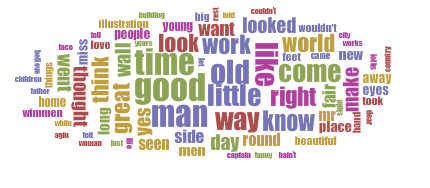
Since I did not have any txt ready censorship data for today’s workshop exercise, I quickly grabbed four Columbian Exposition of 1893 “visitor response” books from Project Gutenberg to use with Voyant in testing text analysis, and this is the (wordstopped) cloud that emerged:

goingtothefair

Clearly visitors to the fair had a good time. They talked far less about art, artists, artistic work, decor, decorative art and crafts. But it was interesting to learn who did talk about those things a little bit, and it was the picturesque guide–a collection of postcards and text showing the buildings and exhibits of the fair. When I went back to the full text, this made sense, as the picturesque guide was explicitly describing visual works. So I learned something that kinda sorta reconfirmed what I already knew about the texts. But I also learned that the so-called “ordinary” visitor to the fair wasn’t even remotely thinking in terms of conventional art terms for describing their experiences, maybe weren’t even thinking in terms of describing them visually. So I would have to go back to a close-reading of those particular texts to learn more about how art/decorative art was or was not revealed in these texts.

Mapping Film Censorship

While I found the mapping work on Friday interesting, I don’t know how much it could bring to a study of film censorship that isn’t already pretty clearly known. Whole books have been written on the cities and states that brought legal challenges to the showing or banning of films and the pattern is also pretty clear–challenges were most often brought in Chicago, New York City, and the American South (most frequently Kansas City, but also Memphis, Atlanta, and on down to very small towns). The two biggest municipal areas in the US before 1950 with very diverse populations having clashing opinions on rights and values, and the relatively homogenous Bible Belt with a dominant class who held uniform opinions on rights and values that they perceived as being at odds with Hollywood.

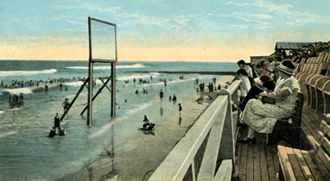
"Movies 'Over the Waves' at Lumina Theatre, Wrightsville Beach, Wilmington, N.C., 1931" in Durwood Barbour Collection of North Carolina Postcards (P077), North Carolina Collection Photographic Archives, Wilson Library, UNC-Chapel Hill.

“Movies ‘Over the Waves’ at Lumina Theatre, Wrightsville Beach, Wilmington, N.C., 1931” in Durwood Barbour Collection of North Carolina Postcards (P077), North Carolina Collection Photographic Archives, Wilson Library, UNC-Chapel Hill.

This is not to say that mapping couldn’t be useful to a whole range of aspects of film studies. One of my colleagues at UNC, Robert C. Allen is constructing a digital history of filmgoing in the South (starting with North Carolina and the collections of DocSouth in the UNC libraries) called Going to the Show, beginning with fire insurance records and street block by street block maps. The project is layered and growing and now includes, in addition to mapped theater locations, a set of architectural plans for 23 North Carolina theaters and a case study of the film experience in Wilmington, NC in the first decade of the 20th century.  At my own institution, I see Allen’s project as a model for a multi-modal project with an eye toward sustainability that engages fellow scholars and graduate students in a creative way and that utilizes the unique collections of a particular archive in a way they hadn’t previously considered .

Baby Face Lobby Card Annotated with Thinglink

So this image was annotated with the actor names (and links to their Wikipedia bios) in Thinglink, embedded in the post, and then, AND THEN, I could annotated it further from within the post (the comment about the wedding ring). AND THEN, my annotation updated on Thinglink, and my edits to annotations on Thinglink updated on this post. So much potential here.

“Use men to get the things you want!”

The above quote comes from Baby Face (1933), a “Pre-Code” Hollywood film starring Barbara Stanwyck that embraced Nietszche and exploitation as a primary means of Depression era survival. This did not go over so well with the newly empowered MPPDA, who upon enforcing their Production Code in 1934 required that any re-release of this film have the offending Nietszche material cut out and replaced by a new voice-over containing a moralizing lecture (and at least an implication that the book in the scene is a Bible, rather than the writing of Nietszche). No master and slave power dynamic and more a cautionary “there is a right way and a wrong way” for Lily Powers to get along in the world.

I think this is an appropriate choice for today’s workshop response, since we were tasked in the afternoon with “exploiting” one of three free content management systems–Drupal, Omeka, and Scalar–to see if one of them would suit our particular project. And because I tested Scalar using the above offending scene, creating a film and censorship project (still private, but also with all of one page and 2 media items in it, so not that interesting to the outside observer yet). I was attracted to Scalar because it was designed specifically to be used with multimedia projects using images, video, sound, etc, because a lot of those kinds of files could be linked in from outside sources (so not having to have a lot of server space built in for large media files), but also because, as I said to my other Scalar-testing colleagues at the table, it is rather like a “Choose Your Own Adventure” book, based on nodes and paths but not requiring a linear structure and including other visualization techniques to link data within the project.

Scalar was somewhat the reverse of my experience working with other CMS or blogging tools like WordPress, in that it required me to ingest or link to my media first and then build pages, comments, notes and annotations around that media second. Easy enough to re-orient myself to, and also not requiring me to have a grand plan or structure from the start. And the annotations and tags are truly wonderful. I could annotate my video clip, starting at the moment where the cobbler invokes the great philosopher and ending with Lily’s thoughtful “huh” (notice the clip above is just pulled in from Youtube and has no annotations). The annotation could include detailed text explaining why I made that particular choice (Here Be Voice-Over after The Code!) which would pop-up under the playback of the video when it came to the annotation starting point. Tags could be anything I want, and would be created as a page within my project, which meant that I could Tag any media object or other page, as well as add further explanatory information, links, bibliography or notes to the Tag itself–my first tag was “Pre-Code” and I can see how that could use some defining for audiences not familiar with the brief period from 1930-1934 when the MPPDA had a written censorship code but the studio members really didn’t make any attempt to enforce said self-produced code until further threats of Catholic boycotts forced them to finally capitulate and set up an office that would police the industry until 1968. I could add links to wikipedia, PDFs, and more. And, with more items tagged, and more tags, I could very easily look at my project as a network visualization (tags are links, lots of mentions in tags would mean sizeable nodes), showing how censorship could cross studios, films, actors, genres, gender, or any other grouping that would change the mostly linear and anecdotal story of film censorship in current scholarship. And I could see all of this potential after only an hour-and-a-half of work, which was even more exciting, especially if I am hoping to have students engage with this tool for a course assignment.

What online film repositories? You mean Youtube?

The plan for tomorrow during the workshop (#doingdah14) is to strategize about the kind of collection building or utilizing that will be necessary to form the foundations of our projects. This I know, as a Visual Resources Curator who has been engaged in image repository building for over 10 years. But this is also where I feel like my particular project, centered as it is on commercial Hollywood films, is also behind the eight ball. The eight ball being the MPAA in its lobbying form, which has worked to make copyright for film so restrictive that many scholars who work in film studies can’t even obtain the appropriate film still photography to accompany their arguments in books and essays because the film studios who own and distribute that material just don’t feel like making those stills available to you, “but here is a set photograph of a totally different moment in the film that you can have because we already had that one ready to go.”

For teaching, the situation is somewhat better relative to copyright. Because of fair use, and in particular because of specific language written into the DMCA of 1998, I can show brief chosen film clips or whole films in my courses. However, my students have to check out DVDs from our extremely supportive but hamstrung Media Resources Center (2 copies on reserve per course), or rely on their own private Netflix accounts to watch full films, and the ongoing UCLA legal case regarding streaming films for a course leaves undetermined the consequences if I should choose to make a film available for streaming on my own through the course management system (Blackboard or Sakai or the like). And very few online repositories are engaging in film collection building beyond what is already available in the public domain. There I have options, usually the best being the Internet Archive. Silent films I can have access to online. Everything else is questionable. And potentially illegal or expensive or unsustainable (I wonder how many people know that films currently on Netflix might not still be there tomorrow. And how efficient is it to have to access whole films rather than the specific clips you wish to analyze and read closely?)

There is always Youtube. Films uploaded in ten-minute increments of terrible quality (HD is now becoming somewhat more common) and of questionable legality because a single take-down notice from MGM (or more likely Turner Entertainment Co., who owns the MGM back catalog) can get it removed instantly and the onus is on the uploader to prove their fair use to get it put back again.

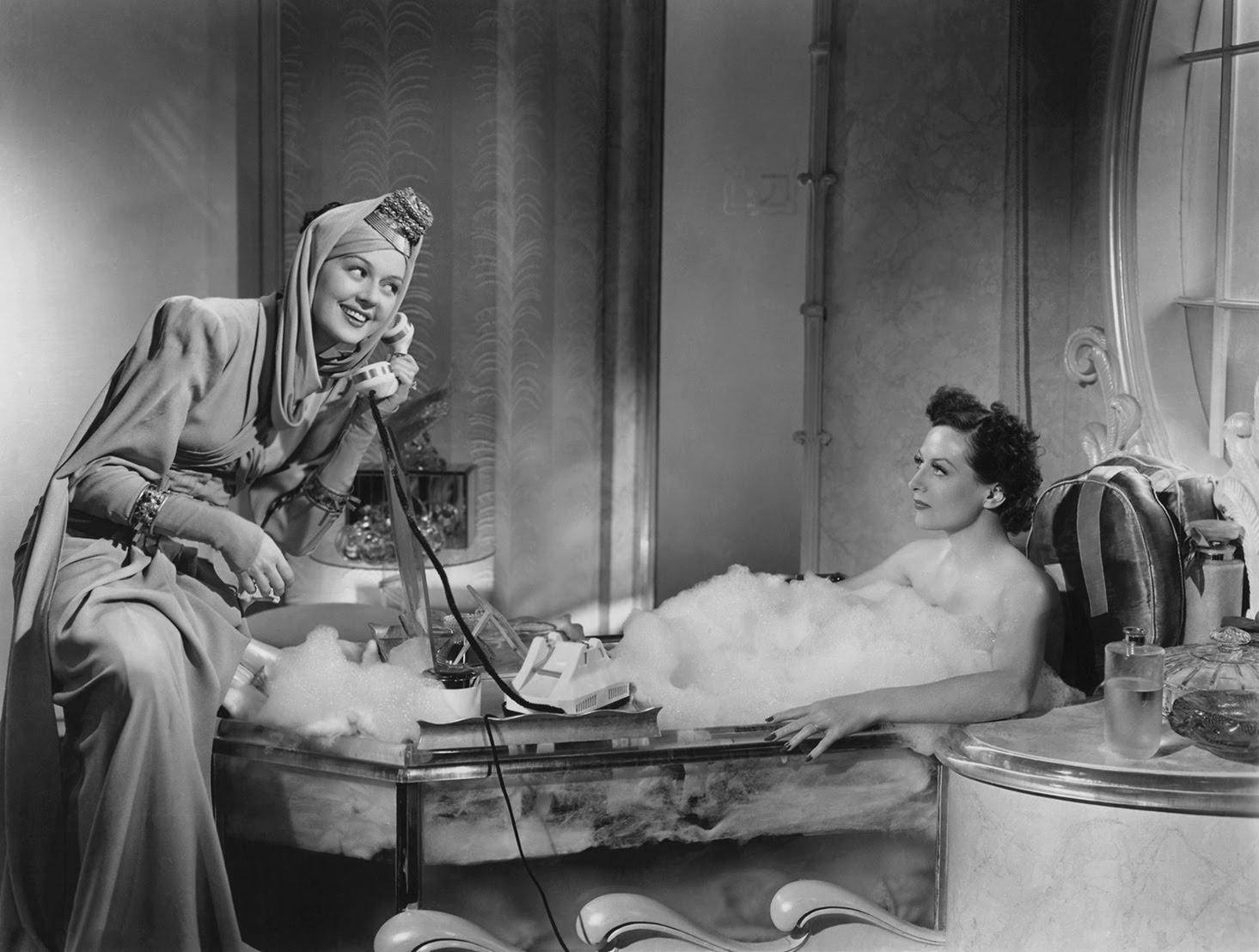
joan_crawford_rosalind_russell_thewomen28194729_01a-734247

So part of my project is to again grapple with collection building of a very different type. To utilize multimedia CMS platforms such as Omeka or Scalar, and repository storage sites like the Critical Commons in order to compile many examples of moments, scenes, comparisons across films, across genres, across eras, in the way that makes the most sense for film studies, as they play out over time. Use fair use to bolster my case as for why a repository that includes a 3-minute clip of Joan Crawford taking a bath in The Women (1939) is neither an excessive excerpt nor adequately substituted for analysis and pedagogy by a still image. And hope that it can prove useful for wider public engagement on the topic of censorship in our society (aided and abetted by the official MPAA stance on copyright). And, ok, maybe not see the MPAA as the enemy altogether, since they have made their archives (especially the written records of their predecessor and creator of the Hays Code, the MPPDA) accessible online here.

« Older posts Newer posts »