Beyond the Women's Building

Women Architects and World Fairs

Page 7 of 8

Examining Jaskot’s “Digital Art History as the Social History of Art”

In his article “Digital Art History as the Social History of Art: Towards the Disciplinary Relevance of Digital Methods,” Paul B. Jaskot outlines the ways in which he believes digital methodologies could alter how art historians frame their questions and offers some examples of what new frameworks could result from the usage of digital tools. Jaskot doesn’t just ask the question, “How can we use digital art history methods to support current research methods?” but goes further to ask, “How can digital art history as a methodology change the nature of the field?” He begins his article by placing digital art history in the context of critical art history by first addressing that in order for digital art history (and digital humanities in general) to thrive, it cannot be ignored that digital tools have often been the product of profit-seeking corporations. If we are to look at digital art history as a new methodology, we must acknowledge that we are beginning with a set of tools and frameworks that have roots in white, male, wealthy, Euro-centric perspectives. Jaskot uses this as a transition to his main argument that digital art history methods are uniquely positioned to analyze a much larger swath of society beyond dominant narratives, allowing bulk data to tell a story rather than granular interpretation of objects. A particularly salient point made is the vital difference between “digitized” and “digital” art history; Jaskot points to Johanna Drucker’s essay “Is There a ‘Digital’ Art History?” as the origin of this line of thinking, but ultimately finds that Drucker is still viewing digital art history as an extension of traditional art history frameworks and methodologies. To Jaskot, this is still a digitized point of view rather than a digital one, and in response he calls for a more nuanced analysis of the interplay of art historians’ tools, methods, and topics that ideally moves away from single-object focused meaning-making and into a wider analysis. Ultimately, Jaskot is advocating for using the disruption caused in the field by digital tools as an occasion for a more critical re-examination of current art historical research, allowing new questions and connections to be developed in conjunction with new high-capacity digital research methods.

In his current research, Jaskot uses the method of visualization to more critically examine cultural forces at work in his area of study. The project he discusses in this article that supports this use of wider frameworks for meaning-making was one that he published with Ivo Van Der Graaff, titled, “Historical Journals as Digital Sources: Mapping Architecture in Germany, 1914–24.” Jaskot uses some of the final resulting maps generated from this project in his article on digital art history to touch on one instance in which large-scale analysis can be more successful at illustrating relationships and their interplay with overarching social structures. His work is uniquely posed to explore wide-scale geographic visualizations; as a scholar of German architecture in the early to mid 20th century, he often focuses on Nazi Germany and the ways in which construction was used to enact violence. This topic is so embroiled in place and imperialist expansion,and benefits from the opportunity to impart scale visually. In his mapping project, he and his co-author Van Der Graaff had the goal of analyzing whether the process of construction itself was meaningful in the larger social and cultural landscape of Germany at this time. They describe the role of social art history in this process as “[…] not to explain a few monuments but—through a focus on what was built, where, and when—to increase our knowledge about the very social structures in which architects and buildings dynamically participate.” Van Der Graaff and Jaskot’s usage of tools in this case also provides an excellent example of the fundamental shifts in question-asking and meaning-making that Jaskot refers to in his article; rather than interpreting a topic through the lens of “great men” or overarching movements, they were able to look at construction as an expression of systemic changes.

I found this article to be an illuminating introduction to digital art history as a practice; it gives a clear idea of what makes digital humanities research different from current mindsets around sociocultural research. One of the reasons I chose to delve into Jaskot’s research a little further was because it truly is a compelling use case for digital art history methods that addresses how we can best utilize the absolute dearth of information that exists in repositories worldwide. The idea of “bulk” associated with digital records can often be framed as a challenge for archivists, and as a special collections worker who has studied archival theory, it was honestly slightly refreshing to see a researcher take that idea and put a more positive spin on it. Every record is a potentiality; having many records to comb through for relevant information forces creativity in their navigation. He also touches on some foundational appraisal theory with the line, “[…] more data does not equal more truth.” This resonated with me, and clarified Jaskot’s point that research (and especially digital methods of conveying research) is not necessarily a definitive statement, but an illustration of a specific web of relationships. The goal of creating a GIS map system such as this is not to lay bare the political and cultural landscape of Nazi Germany, but to illustrate patterns that may indicate connections between historical context and architectural form. This push and pull between retaining the characteristics of individual objects while at the same time examining their context in a wider system is certainly a tension more easily explored through digital tools that have fewer restraints on form. However, I would be curious to hear more about Jaskot’s opinion on how spatial analysis and social network analysis have facilitated the most “productive questions” of the four methodological areas he lists. “Digital storytelling” is a very wide and somewhat general description of a methodology with what seems like the capability to encourage more laypeople to engage with critical art history thought, and I would be interested in hearing about why exactly Jaskot has chosen not to examine this methodology further. Although, I will grant that since he is an architectural historian, spatial analysis is a far more natural expression of his research.

Works Referenced

Jaskot, Paul B. “Digital Art History as the Social History of Art: Towards the Disciplinary Relevance of Digital Methods.” Visual Resources 35, nos. 1–2 (2019): 21–33. https://doi.org/10.1080/01973762.2019.1553651.

Jaskot, Paul B., and Ivo Van Der Graaff. “Historical Journals as Digital Sources: Mapping Architecture in Germany, 1914–24.” Journal of the Society of Architectural Historians 76, no. 4 (2017): 483–505.

Art Historians As Purveyors of Digital Humanities

23 August 2026

For my first blog post of the semester I chose to examine Alison Landmead’s “Art and Architectural History and the Performative, Mindful Practice of the Digital Humanities” (2018). I found that the article was a comprehensive, yet rightfully critical overview of the benefits and pitfalls that art and architectural historians often encounter in using visual reproductions of objects in their work. With Langmead serving as the director of the Visual Media Workshop at the University of Pittsburgh and holding faculty positions in the Department of Art and Architecture and in the School of Computing and Information, I would expect that her work in the digital humanities significantly impacts how she approaches the field. See her bio here.

Landmead’s article begins with an overview of the different visual reproduction methods art and architecture historians have used in the past. Beginning with later slides and later adopting the 35mm film slide, art historians have long sought out reproductions of the works they study for research and classroom teaching. Unlike in English Literature for example, the corpus of work used by an art historian cannot be easily duplicated and mass produced, leading to issues of accessibility. Oftentimes art historians are working with unique pieces that are housed in museums—or worse, private collections—that cannot travel. Image reproductions in the form of slides have been essential in the field for decades to bring the corpus of work into the art historian’s office. 

But, as Landmead herself points out, image reproductions are riddled with unexpected distortions and errors that often go unnoticed by the untrained eye. Color in particular is difficult to capture, as environmental factors such as lighting can alter the way an image in captured on film. Moreover, slides naturally degrade over time, causing colors to fade and bleed. Scale and proportions are also difficult to capture, as 35mm slides were standardized in their proportions. Two-dimensional works of art translated relatively well to slides, but any object that has texture or is three-dimensional will lose certain aspects of its depth when translated to a two-dimensional medium. 

35mm slides from the collection at the School of Visual Arts, New York, NY.

Image courtesy of the School of Visual Arts Library’s Visual Resources Center


The transition from 35mm film slides to digital images around the turn of the twenty-first century has brought its own challenges to image “accuracy” for art historians. Digital images require computer screens to view, which can slightly alter the colors of an image from its original. Moreover, computer screens are available at a wide array of different resolutions depending on brand, age, and price, resulting in different viewing experiences from screen to screen. A Dell monitor may show a digital image of a painting to be more cool in tone than an iMac, greatly affecting the coloring of the image and disadvantaging scholars with lower-quality or older technology. Classroom projectors face the same issue in displaying digital images for teaching. Institutions with higher budgets may elect to purchase higher-quality projectors for their classrooms, disadvantaging students and academic departments with lower budgets in their studies. 

Beyond image accuracy, digital images bring their own preservation problems to the hands of digital humanities. While slides physically degrade over time, digital images can become corrupt or obsolete as technology advances, rendering them completely unusable. A slightly discolored 35mm slide can still be used with the caveat that it is discolored, but a corrupted digital file is oftentimes unsalvageable once damage has been done. Moreover, digital files have to be transferred from storage solution to storage solution as technology advances so they can still be accessed. This is a necessary step for researchers because as technology progresses, the systems used to access old storage solutions become more and more difficult to access. But files can become corrupt if not transferred properly, increasing the risk of losing years of visual resources. 


Alison Langmead’s article provides an excellent case study for researchers in the humanities as a whole to incorporate the use of digital technologies in the way they conduct research. Langmead is correct in her argument that art and architectural historians have been using digital technologies for decades in their work, as there are few other disciplines in which scholars are so physically far removed from the material they study. Before the rise of lantern slides for academic use, art historians were forced to rely on “mass” produced copies (that is, more mass produced than the original works) such as prints or plaster casts for study, which were riddled with inaccuracies themselves. Gotthold Ephraim Lessing’s now fundamental “Laocoon: An Essay Upon the Limits of Painting and Poetry” (1766) is an excellent example of this. Written about the Laocöon statue group now housed in the Vatican Museums, Lessing’s essay was about a sculpture he only viewed from engravings, as he never actually travelled to Italy to see it in person. His essay was partly a response to Johann Joachim Wincklemann’s essays concerning the sculpture group (“History of Ancient Art”, 1756), but his thorough analysis of the aesthetics of the Laocöon group figures came from secondhand source materials. 


With all this in mind, what insights can art and architectural historians provide to the humanities as a whole in regards to digital methodologies? Digital tools oftentimes increase the accessibility of bodies of evidence, allowing researchers to access them from anywhere with an Internet connection. The rise of digitized materials such as books and archives in the last twenty years have shown that if materials are more accessible people will use them. But humanities scholars can incorporate digital tools into their methodologies as well as their source materials. Scholars of literature have increasingly turned towards tools such as text mining to look for new patterns in bodies of work that would otherwise be impossible to sort through. More humanities scholars have turned towards spatial mapping in the form of geographic information systems (GIS) to analysis patterns of movement and settlement, allowing for new breakthroughs in scholarship. 

At the end of the day, the humanities keep evolving as technology does, allowing scholars to develop new ways of thinking about their fields and sharing it. 

Writing Assignment #1

Historically, the field of art history is a discipline that uses the most current technology for photo and video projection. Now in the twenty-first century, the rapid innovation of analytical digital tools presents the discipline with the opportunity to integrate these tools into the field’s research methodology. Similar arguments and themes about the nature and future of art history in a digital world are articulated in articles by scholars Harald Klinke, Paul Jaskot, Alison Langmead, and Amanda Wasielewski and Anna Näslund.1 Aside from the utility of digital methods for art historical analysis, Kelli Marshall and Miriam Posner explain the importance of an academic digital presence and practical suggestions for scholars.2 The report compiled in 2014 by Matthew Long and Roger Schonfeld shares current methodological trends and recommendations for art history.3 The combination of these articles, blog articles by Posner and Marshall, and the report by Long and Schonfeld indicate that art history will be indistinguishable from digital art history in the future.

In Harald Klinke’s article, “The Digital Transformation of Art History,” he seeks to define digital art history and asserts that it will become more than another method, but redefine the field of art history itself.4 He introduces the idea of “distant viewing,” a method of examination that involves analyzing large quantities of images, that will make digital methods an essential part of the research process.5 This process takes into account not just “masterworks” but also “lesser” works that fall short of high volumes of scholarly analysis. Digital methods, Klinke asserts, allow a macro-analysis that facilitates art historical analysis. Klinke indicates how these methods are changing the field’s curricula, role of the teacher, the department, and the discipline as a whole.6 Klinke believes that art history should adapt to accommodate these changes by including software and digital resource instruction in the curriculum. With this mode of instruction, the teacher transforms into a guide, and the department must intentionally create spaces for collaboration. This transition into a digital space allows for greater transdisciplinary collaboration.

Similar concepts of transdisciplinary collaboration, digital methods for macro-analysis, and the necessity to create shared spaces for collaboration are also present in the articles by Jaskot and Langmead. Jaskot theorizes in his article “Digital Art History as the Social History of Art: Towards the Disciplinary Relevance of Digital Methods,” that digital methods can help analyze the relationships between art and society.7 He writes that through network and spatial analysis of large quantities of data, reminding the reader of Klinke’s concept of “distance-viewing,” patterns can be illuminated to provide evidence for scholars’ claims. Klinke outlines four areas that digital methods are helpful to the study of art history: digital storytelling, text-based approaches, network analysis, and spatial analysis.8 He gives preference to network and spatial analysis as methods that present the greatest potential for productive scholarly analysis. Jaskot writes that macro-analysis necessitates collaboration, a conclusion reached by Klinke and Langmead.9

In her article, “Art and Architectural History and the Performative, Mindful Practice of the Digital Humanities,” Langmead explains that the humanities should not take innovations in technology for granted but instead continually engage with them. She points to the University of Pittsburgh’s Visual Media Workshop as an exemplary instance of productive engagement with technology and scholarly collaboration.10 Throughout her article, she traces the history of technology in the field of art history and asserts that a part of it is theatrical, like Wölflinn’s performance-like lectures in the late 19th-century.11 While art history may have lost the social opportunity presented with the physical slide library in the digital age, Langmead explains that the University of Pittsburgh’s Visual Media Workshop is an example of a productive blend of scholarly collaboration and meaningful, analytical engagement with new digital resources.

Wasielewski and Näslund’s article, “Critical Digital Art History: An Introduction,” moves beyond defining digital art history and seeks to critically examine how digital tools have inevitably permeated the field.12 Wasielewski and Näslund apply principles of critical theory to art history by looking inwards to be methodologically self-critical and to examine the social and political conditions of the external environment from the researcher’s subjective perspective.13 The authors also introduce the concept of the post-digital world, one that is inextricably linked to the digital sphere.14 Like Jaskot, Langmead, and Klinke, Wasielewski and Näslund outline the numerous ways in which scholars’ research inevitably uses digital tools to find sources, read, write, and collaborate with other scholars. Although digital practices may resign the scholar to the stereotype of the “isolated” researcher, a negative trend of the advent of the digital world that Langmead also refers to, digital resources open the field to wider audiences and present greater opportunities for collaboration.15

The report compiled by Long and Schonfeld examines the challenges and opportunities of the field of art history and offers practical recommendations to progress forward.16 The report, compiled over ten years ago, already found that art historians’ research unavoidably involves the internet and digital resources from primary and secondary source collection to compiling digital images for research. In its conclusion, Long and Schonfeld note that the methods and practices of art history research will increasingly rely on digital resources.17
Aside from the methodological application of digital resources, Marshall and Posner’s articles, written in a more conversational style, indicate the increasing necessity for academics to create and control their own digital presence.18 Both authors offer their own advice for maintaining an online presence specifically for academic professionals. Marshall suggests creating a website and building a social network while maintaining a consistent professional branding of oneself across these platforms, and Posner offers similar suggestions.19 These methods establish and protect the reputation of the academic professional.

After reading these materials, I noticed that my research and scholarly practice exists almost entirely within the digital space, but I do not use these resources beyond a more efficient substitute for notebooks and slides. Langmead’s article about using digital resources beyond reproductions of images made me reflect on ways that I could also incorporate macro-analysis or distance-viewing practices facilitated by digital resources that Klinke and Jaskot discussed in their respective articles. Marshall and Posner’s articles also made me consider my academic digital presence beyond personal connections. By standardizing my profile between my website and LinkedIn account, I hope to begin establishing my presence online as an academic. These articles indicate that digital resources will become essential to research methodology in the field of art history.

Notes
1 Harald Klinke, “The Digital Transformation of Art History,” in Routledge Companion to Digital Humanities and Art History, ed. Kathryn Brown (Routledge, 2020), 32-42.
Paul B. Jaskot, “Digital Art History as the Social History of Art: Towards the Disciplinary Relevance of Digital Methods,” Visual Resources 35:1-2 (2019), 21-33.
Alison Langmead, “Art and Architectural History and the Performative, Mindful Practice of the Digital Humanities,” Journal of Interactive Technology and Pedagogy, no. 12 (February 2018).
Amanda Wasielewski and Anna Näslund, “Critical Digital Art History: An Introduction,” in Critical Digital Art History: Interface and Data Politics in the Post-Digital Era, ed. Amanda Wasiewleski and Anna Näslund  (Intellect, 2024), 1-19.
2 Kelli Marshall, “How to Curate Your Digital Identity as an Academic,” Chronicle of Higher Education (May 5, 2015).
Miriam Posner, “Creating Your Web Presence: A Primer for Academics,” ProfHacker (February 14, 2011).
3 Matthew Long and Roger C. Schonfeld, “Supporting the Changing Research Practices of Art Historians” (Ithaka S+R, 2014).
4 Klinke, “The Digital Transformation of Art History,” 32.
5 Klinke, “The Digital Transformation of Art History,” 34.
6  Klinke, “The Digital Transformation of Art History,” 36-38.
7 Jaskot, “Digital Art History as the Social History of Art: Towards the Disciplinary Relevance of Digital Methods,” 23, 30.
8 Jaskot, “Digital Art History as the Social History of Art: Towards the Disciplinary Relevance of Digital Methods,” 24.
9 Jaskot, “Digital Art History as the Social History of Art: Towards the Disciplinary Relevance of Digital Methods,” 26.
10 Langmead, “Art and Architectural History and the Performative, Mindful Practice of the Digital Humanities,” 18.
11  Langmead, “Art and Architectural History and the Performative, Mindful Practice of the Digital Humanities,” 4-5.
12 Wasielewski and Näslund, “Critical Digital Art History: An Introduction,” 2.
13 Wasielewski and Näslund, “Critical Digital Art History: An Introduction,” 4-5.
14 Wasielewski and Näslund, “Critical Digital Art History: An Introduction,” 5.
15 Langmead, “Art and Architectural History and the Performative, Mindful Practice of the Digital Humanities,” 18.
Wasielewski and Näslund, “Critical Digital Art History: An Introduction,” 13.
16 Long and Schonfeld, “Supporting the Changing Research Practices of Art Historians,” 42-47.
17 Long and Schonfeld, “Supporting the Changing Research Practices of Art Historians,” 50.
18 Marshall, “How to Curate Your Digital Identity as an Academic.”
Posner, “Creating Your Web Presence: A Primer for Academics.”
19 Marshall, “How to Curate Your Digital Identity as an Academic.”

Finding a “Digital Art History”

week one: 8/18/2026

“The struggles and wishes of our age are, undeniably, wrapped up in computational systems.” —Amanda Waiselewski and Anna Naslund in “Critical Digital Art History”

Digital Art History (or DAH) can refer to both the tools that art historians might use, and a way of thinking about art history. For this week in our seminar on “Alt-Methods: Digital Art History,” we were assigned a number of readings that sought to understand the history behind DAH and what it means to be a practitioner of “digital art history” today. As a defined discipline, it is far newer than art history proper; of course, the very tools that would produce DAH only came about with the widespread popularization of computers. Yet every author we read this week is quick to note just how important technology, whether digital or not, has always been to art historical research. Alison Langmead writes in her “Art and Architectural History and the Performative, Mindful Practice of the Digital Humanities,” that the adoption of the slide projector in the late-19th and early-20th centuries as represented a major shift in the field. Pioneered by art history professor Herman Grimm in the 1890’s, the projector (initially called a “Magic Lantern”) presented opportunities for art historians to teach simultaneous to students and lecture attendants viewing works of art. For a field that relies on the often unsteady ability of words to accurately represent images, it’s understandable that such a device was adopted quickly. Langmean continues, noting that throughout the 20th century, the slide room and the projector continued to be the main tools of art historians and art history teachers. Significantly, not only were these technologies incredibly useful to art historical research, the neccessity of a physical slide library where art historians (often professors and students at universities), were allowed a kind of third-space to meet and discuss their work.

What followed the overwhelming switch to digital cameras, screens, and computers was not a shift away from the use of images and projectors in art historical teaching, but rather, the abandonment of slides and slide rooms. DAH practitioners Harald Klinke and Paul Jaskot both note this discipline-wide shift to the digital as one of many ways in which all art historians are already “digital art historians,” despite the field as a whole tending to look down on novel and creative uses of digital technologies in research. As an art history graduate student, I can attest to the fact that despite my professors’ consistent reliance on digital images, computers, and projectors, very few of them seem to be entirely comfortable with digital technologies and most research outputs are the same as decades past (like research papers or manuscripts). Klinke proposes that art historians already dealing with digital data on a regular basis ought to look to DAH as a means of improving their data literacy: what he defines as the ability to understand and critique where, how, and why data was generated, and further, the ability to recognize the role of algorithms in the filtering of information.

Of course, most of DAH is conducted through projects that use data in digital systems which generate a myriad of formats. My experience in archival roles has given me a greater familiarity with DAH projects than my time as an art history student has. Because archives are interested in making a large amount of data accessible and interesting to the public, digital formats can present so many opportunities. I’ve worked on a couple different projects that had to do with digitizing archives and creating interfaces for audiences to view and sort the contents of the archives. One consideration in these contexts is how we (as archivists) can make our collections engaging, and formats like Omeka are really well suited to that. Another major consideration is that, often, only one researcher at a time can view archival documents in person unless they’ve been included in a physical exhibition. For both art historians and archivists, the tools proposed by DAH can present so many opportunities to expand our audiences. Much like slide rooms in the 1890’s, images and data can be democratized and made accessible through digital technologies. Paul Jaskot even argues that the opportunity to present information as maps might make art historical data itself more “democratized,” in the sense that where a paper typically requires a single narrative, the visualization data offers more potential loose associations.

Nonetheless, these visual data sets do still offer opportunities to present those single narratives—for better or worse. Maps, graphs, 3-D visualizations, and digital exhibits are all subject to distortion and narrativization by their authors. This is similarly true of the digital image which, like the slide image, is only one possible representation of an object. The central issue of reproductions versus reality presented in Walter Benjamin’s seminal “The Work of Art in the Age of Mechanic Reproduction” (1935) remains truer than ever in our digital age. Yet, I would hope that art historians can embrace the digital technologies that we are already using, consider using new ones, and even begin to build data literacy in themselves and their students. The world is certainly not going to become less dominated by computers and digital data anytime soon.

Mapping Project final thoughts and feedback

Wow! January just flew by in the whirl of new semester business. So of course my first post of 2015 is actually going to be a final report on the digital humanities class project from last semester.

Here is the link to the google map the course made: https://www.google.com/maps/d/edit?mid=zDX3AIg56Xx0.kx2jSWf18o-A

  1. There are many more blue pins than red only because I limited the number of built works by female architects for each group to 15 (and for comparison the textbook had anywhere from 7-24 built works per section pinned by an individual in the first layer). Wanted them to do slightly deeper research on the women architects rather than broader. Although students did say that it was in some cases challenging to find 15 built works where they could also find at least 1 image and any useful data about the built work (including, sometimes a challenge, where it was located if it had since been destroyed).
  2. Their work on the first part of the project ranged all over the place from A+ to C (I almost never get failing students because of UNC’s generous add/drop deadline) and this was still fairly obvious from looking at their work on the map, and much of a piece with their other grades in the course. Their work on the second part of the project ranged from A+ to B+, which was a good sign that they had improved since their first try run at it.
  3. I was surprised at how much I learned from their work on the second part of the project, which brought to light, among other things, that a woman received the first patent for an architectural design (in North Carolina, no less!) and highlighted the neglected work of the first licensed African-American female architect Norma Merrick Sklarek (whose firm wouldn’t ever tell clients that she was the principal designer for fear they would bolt from the project). The students really brought a higher level of engagement to this project than I am used to seeing in previous incarnations of the course.
  4. I also took all of their data from the second part of the project and used it to create a google fusion table (found here), to which I added a field for building type (school, museum, office building, etc.) and showed them various ways they could filter the data. One of the charts I had created was a network of building type by year, which revealed that a lot of early women architects built houses and many more current female architects build office buildings—this raised questions for the class and led to an interesting discussion of late 19th female architects finding more commissions for houses precisely because of sesxist stereotypes about the association of women with the domestic realm (they would just be better at houses, because this is where they spend all of their time and provide the most socially appropriate value as wives and mothers) but also how this distribution might reflect the students’ own assumptions and biases in doing their research and choosing which 15 among potentially many other choices to add to the map for a given date range.
  5. The good: Students were asked after the final presentations to give feedback on the project as a whole. Some found the project fun (r.e. the complaint in number 6 below, one student gave the rejoinder “I don’t care, I really liked it, it was fun”), others found it made the built works much more memorable and helped them better understand how to do formal analysis of architecture, others really liked the interactivity of the exercise (being able to add video and images to the pins as well as links, and to then go explore what their peers had created, and move around the map geographically), and others found it made them feel a sense of ownership over the materials they were pinning to the map. They were unanimously in favor of sharing their work outside the class and a couple of students wanted to know if the project would continue to grow after this. One student used his newly acquired mapping skills in an Islamic art class to map artistic commissions by one particular Andalusian caliph.
  6. The bad but fixable: One student complained about the length of time it took to actually make the pins on the map (6 or 7 hours) and so we talked as a group about how to improve that aspect of the project. Most students would have preferred to just put their data and links into a google drive shared spreadsheet and then let me “make” the map with that. Based on how google maps ingests data from a spreadsheet, from a test with some of the female architect data, this would in turn require adding geolocation fields (the map just couldn’t find an observatory in the far north of Finland from the name of the town it was in, as an example), and also perhaps still adding some images via the individual pin on the map (the map couldn’t convert some urls into images and just added them as links to the bottom of the pin description—seemed to do just fine with embedding video urls).
  7. The kinda bad: I paid for Google Maps pro to allow us to put so many pins on the map and in the last week of the course they announced it will now be free. But it was only $5 a month and I can easily get my department to reimburse me the teaching expense of $20 + tax.

Facilitating DAH projects for Art History Faculty

A rare Tuesday DAH post, since the last Thursday in November is a coma-inducing holiday.

In my Modern Architecture course, the Mapping Project Part 2 is still in progress. More on that at the end of December.

But I was not inactive on the DAH front in November. In fact I was much busier than usual, helping to facilitate the use of DH in several art history undergraduate courses. While many faculty meetings recently have included the questions “What is Digital Art History?” and “Should we be doing Digital Humanities?” and “Everyone else is doing this, so why aren’t we?”, regardless of whether DAH is a good fit with their research and teaching or not, some faculty are already integrating technology-based projects and upgraded pedagogical methods in their courses. It just seems like we are all doing it at once in the same semester. And, wearing my Visual Resources label, I am in the position of supporting and promoting these goals.

As part of the Digital Salon Series, a once-a-month brown bag lunchtime demonstration and workshop co-sponsored by the Art Department and the Sloane Art Library, I presented to my colleagues on how to annotate images and build presentations and class projects using Thinglink. Art Historians have at this point become very comfortable, some would say too comfortable, with Powerpoint as the presentation tool of choice in lieu of slides–not with the low-image quality of the projection technology compared to slides–but even so adept at creating a more varied image presentation style than just single slides compared side-by-side. And there are challenges to suggesting that Art Historians now move on from this technology in the classroom: 1) Converting from their slide lectures to Powerpoint files was initially time-consuming, and the time spent re-building slide lectures every year has been forgotten as a part of the teaching process where revision, improvement and expansion of the material could occur; 2) Powerpoint files are easy to save to a hard drive or a zip drive, and even for those who have used the software more dynamically with embedded music or video files and hyperlinks, still viewed as the most secure option when faced with a conference venue or a classroom that might not have perfectly working internet access, despite the reality that internet access is nearly universal and high-speed and redundantly backed up in most of these locations (we have over 30 wifi routers in the Art building at this point, 5 of which were added to back hallways and stairwells this fall just to boost the overall signal); and 3) Powerpoint files represent uni-directional pedagogy and are therefore fully within the control of the professor and representational of their chosen teaching viewpoint, an authority and mastery level that is difficult to relinquish to students. And Thinglink pretty much requires rethinking all of those ideas–not just would you have to rebuild presentations from scratch, and work directly within the web rather than from the safety of your zip drive, but sharing with students or on a website can lead to interactive responses and new mixes of the lecture content. We are already handing over so many of our technology needs to Google and its development team (and what exactly are they doing with our data and what do we do if they decide to stop developing our favorite tool), that the corporate structure behind Thinglink still makes one pause at the idea of making it a permanent replacement for a stable and successful software tool like Powerpoint. And the responses to the demonstration were uniformly positive (challenges addressed! level up!). Many faculty saw the value in using Thinglink for immediate in-class quiz and response or peer group activities where many different types of research could be demonstrated (attach a video! link to a survey! add to a blog!). The education technology specialist from the Ackland Museum saw a way to create online guides to individual works in the collection that could be easily integrated into the Ackland Museum website, produce exploratory annotating directly on the image instead of alongside it, and also allow for audience commenting and interactivity with the image of the work. And, bonus, my colleagues also found annotating directly onto images to be fun and expansive (or, in my case, down-the-rabbit-hole time sucking and, okay, maybe kickstarting my first idea for a Valentino-related essay for the website).

Also, the VRL became a classroom computer lab for a colleague’s Islamic Architecture undergraduate course. As part of the course, students are investigating architectural fragments in the Ackland Museum collections. For that investigation they were given two digital assignments, one using a Gigapan camera mount to make a large-scale panoramic photograph of the front of a fragment and the other using their phones and ipads and digital cameras and the software 123D Catch to make a rotatable 3D model of a fragment. The VRL became their classroom workspace for stitching together their many photographs into a single panorama and 3D model, which they would then utilize in a future class for a close observation exercise. The goal was to get the students to look at the object from a new perspective as well as to explore new technologies for object-based research. Overall, the lab sessions were successful and also somewhat surprising: students showed up for the lab session and just started using the installed software to stitch their images without even waiting for the professor or myself to give preliminary instructions, which meant we spent most of our “training” time on getting students to back themselves out of corners they had painted themselves into with the tools (especially when it came to choosing which photographs to use in the final image–the stitching software for both had a hard time with out-of-focus images and the students hadn’t looked at their individual photographs in advance to choose the best ones). And we saw a wide-range of success or not with the tools and projects, including students who couldn’t get their images off their zip drives or SD cards, students who couldn’t get their too large image files to load into the 123D Catch online library (5 MB max!), students who hadn’t really taken enough photographs (if you are making a 3D model, you need to remember to take pictures of the top of the object!), and a multitude of editing glitchiness (take out an intervening blurry photograph and you get Frankenstein-stitched stumps of objects). But we also saw a group of students who were enthusiastically engaged for the full class time, trying to find alternatives and solve problems as they went, and proud of the resulting images they created. The professor and I learned pros and cons of each process and software tool as well: Gigapan.com went out of business at the end of October and their stitching software could no longer be licensed but we could demonstrate how to stitch images in Photoshop as a secondary option; 123D Catch’s online editing tools were broken (a hopefully-soon-to-be-repaired plugin issue with browser updates), and images weren’t successfully uploading from Android phones, but the iPhone and iPad apps worked like a dream, instructed the students on where and how many images to shoot, and instantly created the best 3D models of the bunch; and older model cameras (without internal leveling mechanisms) produced the hardest to work with images, so we need to have newer cameras for students to use.

First Phase of the Mapping Project is Complete!

Well, this is a little late, but October is the crazy middle of any semester, with too much to do between grading two writing assignments and evaluating the first phase of student work on the mapping of modernist architects. And technology taketh away even as it giveth: an external hard drive with all of my teaching materials (7 years of syllabi, lectures, powerpoints, images, film files) died, kind of came back to life for a week to allow me to rescue material one file at a time, and then died again for good. In case you are immediately asking, what about the backup? I did have a backup, but it also failed (I got a message telling me “unspecified errors” were preventing me from accessing the backup, which was so. not. helpful.). But the data (literally) is in on the mapping project–what have I and the students learned?

1. Even with very specific written instructions (reiteration of what was also communicated in class during the technology day), students will ignore instructions and do their own thing. I had so much variety in the pins, labels, additional description/text/video materials from students. Some students just placed a pin on the map, without adding architect and date information, or images, article links and videos to supplement their pins as had been requested in the assignment. Some students, on the other hand, gave me an abundance of links, long descriptions, and some students even tried to take up the idiosyncratic challenge of finding a video to relate to each of their pins for a built work on the map. On the plus side, everyone did place pins for most of the built works in their assigned section of the textbook–no abstentions, and no students who missed pinning more than one or two built works (one student jumped over Switzerland in his textbook section and then showed me his used textbook with those pages missing–now, he could have torn them out himself, and he also could have looked at the actual page numbers to realize he was missing something, but it was an anomaly among his otherwise complete pins for the rest of his section). Using technology in pedagogy doesn’t substantially change the instructor’s ability to see clearly who is doing A+ work and who is doing C- work.

2. The students weren’t yet thinking of the project as a whole beyond the pins for their sections of the textbook. During the class discussion where we evaluated the whole map together, students did not seem to have any new insight into modern architecture when seeing it represented geographically in total. This was a disappointment for me because I thought that seeing the huge gaps in geographic representation (almost none of Africa south of the Mediterranean fringe, none of China–or Canada for that matter–with pins) would start discussion about possible textbook bias and/or the problematic first world origins of “modernism,” its definition and its global spread. My students don’t have a very good grasp of global history in general, and I am uncertain about how much of this I have to incorporate into an art history course just to give them the proper context in which to see modernism as a broader concept but also as a specific architectural and cultural agenda of the 20th century.

3. Based on a small sampling of individual student feedback (from students who actually talk to me outside of class), they liked doing the mapping itself. One student is using the new skill to create a map in an Islamic art class, where he will map Andalusian Caliphal architects, which his instructor is also enthusiastic about. This did make me realize that I need to ask for student feedback in general on the project as we go along, rather than wait for it to come out at the end of the semester in course evaluations.

Student teams of 3 have already started adding pins for the second phase of the mapping project, mapping built works by women architects. Using the Virginia Tech International Archive of Women in Architecture as a starting point for research, each team will be mapping at least 15 built works for a given date range and with the proviso to have at least 3 different women architects represented among those fifteen (especially didn’t want to see the last decade plus become the “Zaha Hadid” years, when there should be more female architects than ever to choose from). To increase the in-class assessment of the pinning exercise, each team will be giving a lightning presentation of their research results on this portion to their peers during the final exam period.

The Perils and Pitfalls of Group Online Work in Google Maps Beta

As promised, this Digital Art History Thursdays post is about the progress that has been made in my Modern Architecture course in using Google Map Engine Lite (now out of beta and officially My Maps) to create a group map. Phase one of the project will be finished in mid-October, but the following issues arose as we got started:

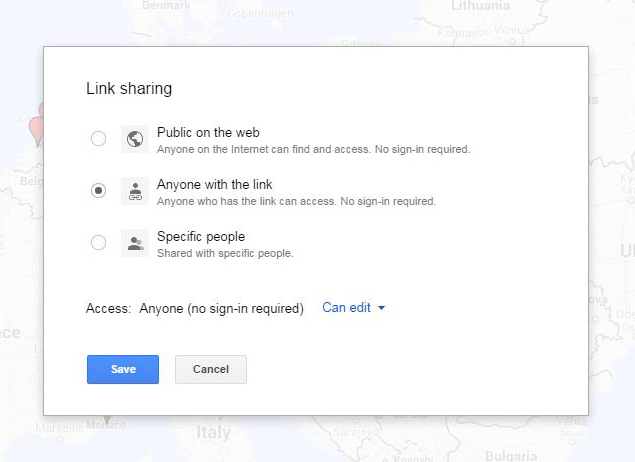
1. Google, in various ways, provides incorrect information about how to share maps in such a way that all users could edit the map. Below are the options that Google gives you for sharing maps.

Google Map Sharing

Since our map was for class purposes, and would likely have some bumps along the way, option 1 was discarded immediately. The class will vote at the end of the semester about whether to make the final map public or not. In theory, I could have used option 3 to share with all of the students in the course by entering their individual email addresses into a list and letting them access the map by signing into Google, but this too was discarded as an option because Google rejected their university email addresses out of hand (and one at a time also–I would delete an email from the list and Google would reject another, and so on) and because the task of collecting everyone’s gmail address (and because some students did not have gmail addresses, which I did not want to force them to create) would have made the sharing process too piecemeal and drawn out instead of giving everyone equal access from the first day. So I chose option 2 and emailed the map link to all of the students via the course Sakai page–they could bookmark the link and Google (supposedly) wouldn’t care what email address they had or even who they were when they accessed and edited the map. Easy, right?

But then a student tried to access the map, and this is where things were clearly not as advertised. Notice above that option 2 says “no sign-in required” and that the access level is “Can edit.” My student could view the map, and could even see a red Edit button in the top right corner of the map toolbar on the left side of the map. However, clicking the Edit button resulted in nothing. Searching for a place in the map search bar would drop a green pin on the location, but that green pin could not be grabbed and added to the map. The student could, in actuality, not edit the map. Nowhere in the Google support documentation does it indicate that sharing maps requires signing in to Google before one can edit a map, but that is the truth that several independent help forums had conclusively discovered. Every student, even the ones who had not previously had gmail or Google accounts, had to now sign in to Google to be able to edit the map.

So Google lied. But it was more like they lied out of ignorance about how their own tool was supposed to work than to deliberately obfuscate. In theory, maps work like docs on Google Drive. In practice, Google’s My Maps can be viewed by strangers (to Google) but only edited by friends (of Google). Something to consider when looking for a more open tool for classroom use.

2. We also discovered that, despite the promise of the ability to add data to a map by importing it from an Excel spreadsheet, Google only allows one spreadsheet import per layer of the map. Out of general assignment fairness, I couldn’t allow the first student out of the gate to have this ability and then deny it to everyone else. This required a bit more logistical thinking before coming up with a procedure that could be used by the whole class.

I could have had each student make a layer, and, since I have a Maps Pro account, we would have been able to have that many layers (times 2, because the students would be doing the same thing for the next phase of the project), but this would also have been difficult to read through on the maps toolbar and also open up a lot more room for importing and data entry error (data columns in different orders from layer to layer, less accurate place locations found, etc.).

Or I could have had every student send me their spreadsheet data a few days in advance of the phase one unveiling and then I could have synthesized their data into one sheet and uploaded it to the map. Since part of the goal of the project is to have the students get hands-on with the digital tool, this was an obvious nonstarter.

So, instead of adding data in sets, each student will be adding individual points to the map for their assigned “section” of the project. Already we have seen that the map search bar can find built works at their actual physically specific street address, so the pins will be very accurately placed on the map, without the students having to enter GIS coordinates. The students can still copy and paste prepared data from their spreadsheets (which is the part of the assignment that will be turned in for the actual grade). And they can more directly and easily add images and video directly from the pin editing function using Google search. Since most students will be adding 15-20 pins, taking the route of adding one item at a time is not excessively burdensome as a whole.

For the next blog post, a report on the results of phase one of the mapping project.


Practicing Digital Art History

I spent two weeks this summer participating in Rebuilding the Portfolio, an introductory digital humanities workshop for art historians sponsored by the Getty Foundation and held by the Roy Rosenzweig Center for History and New Media at George Mason University. After two intense weeks that one of my colleagues nicknamed “DH bootcamp,” I returned to work eager to implement some of the things I had learned. So here are some thoughts now that the fall semester has begun and I have time to evaluate where I am in terms of practicing digital art history.

Public Scholarship

Ha! I have been so busy getting my syllabus and sakai site together for my fall course in modern architecture, as well as performing departmental service in the form of updating art.unc.edu to reflect all of our upcoming fall activities, add new faculty members and staff to the website, and post news about everyone else’s busy summers, that I haven’t really found the time to figure out when and how and what public engagement will look like for me. So this is what I have done so far:

  1. I organized my Twitter feed using Tweetdeck, which has been very illuminating and helped me keep the flow of information in some more tidy categories, including #digitalhumanities and #doingdah2014 as well as inspirational tech and GLAM feeds. As a result, I have tweeted and retweeted to keep relevant dah news stories, gained followers, crossposted things that I have discovered from other dh and daher’s to the vrl facebook page (and picked up some more facebook followers too!), and in general feel like I am now a part of the digital humanities conversation on Twitter, where so much important news and information gets shared.
  2. As you can see from the date of the previous blog post compared to this one, I have not been quite so active on my new website. Okay, so for a week my website was suspended by ICANN because they couldn’t verify my email and it took a while to figure out that the extremely antihacking security-conscious spam settings on my university-based email account kept garbage-binning their confirmation requests and giving me no way to see or retrieve them to fix the problem. Asked for help on Twitter (again, yay!) and in an hour knew that changing my email address associated with the website was the answer. But I can’t say I have been proactive in fleshing out the website or making time in my schedule to write regular blog posts. My goal from today is to write something relevant to dah, art history, or my teaching every other Tuesday.
  3. Art History-related aside here: I am really struggling with what the “look and feel” or “brand” of my website should be. So many themes! So many visual styles! Add images, colors, boxes, and more! When I was in graduate school, I worked for an ad agency, managing accounts’ trade show events, which included working with the agency art director on messaging; currently I manage the art department website (also on WordPress), for which purpose I have read many texts on promotion, marketing, and how to engage with the public on the internet; and I spend an awful lot of time in my classes making the argument that the visual matters in our everyday lives. At the moment I feel paralyzed by something that should be so easy (and to all of the bloggers I follow, whether in the GLAM world or in theater or in crafting, congratulations on solving the basic problem of how to communicate your identity clearly on a website because that takes a lot of work!). For now, I will probably try on many identities, themes, etc. as I try to also figure out what being a publicly engaged digital art historian means for me.
  4. I don’t have a scholarly project to develop, discuss, share, or otherwise make public. The project I thought I wanted to do (censorship and film) is perhaps not what I need to do right now. And I have just become involved in a new GLAM-related project about which I cannot yet speak publicly as it hasn’t been officially announced. Right away, logistical constraints appeared which have nothing to do with my desire to engage publicly.

Pedagogy

On this front, I have been more immediately successful and exciting things are happening!

  1. I have changed the syllabus for the modern architecture course to incorporate a digital project this semester. Student evaluations have in the past revealed that, while students enjoy the course and actually seem to like the writing project, they hate exams that are based on rote-memorization and the spitting out of the appropriate vocabulary. And yet, since there is not a more introductory architecture course as a prerequisite to mine, I need for them to learn and retain basic facts about modern architects and their built works. So, to approach that goal digitally, the course will instead of exams be undertaking a two-part project which will a) map the architects and identified built works from the textbook, William J.R. Curtis’ Modern Architecture since 1900 and b) research and map modernist women architects’ built works on top of the first map, which we will then compare and discuss as a group in class. Win-win. The students get to engage with creating digitally rather than just consuming digitally, and in the process the basic facts of architects and built works will be better retained because of how the students had to engage with the source material. I will post updates on this course project as the semester goes along.
  2. I have consulted with a colleague in the department about supporting a digital project in her fall course where students will be trained to use a Gigapan camera mount to make and then stitch together Gigapixel images of a work or works in the Ackland Museum. This will be a collaboration between the Sloane Art Library (who own the Gigapan mount and necessary tripod), the VRL (where the Gigapan Stitch software will be learned and then used to make the final images) and the Ackland Museum (who will be providing the objects and the space in their digitization lab for the photographing of those objects). This will also result in a presentation on the project to the Art Department as well as in the new UNC Libraries Research Hub. Cross-campus connections are being forged.
  3. I have surprised my colleagues and myself by producing and submitting a fully-fleshed out syllabus for a digital art history graduate-level course in the department, to be taught in the fall of 2015 if approved. This became an urgent necessity after the departure of a colleague in the School of Information and Library Science for the University of Maryland and the disappearance of his digital humanities course with him–this course had been much-utilized by our dual degree Art History MA/Library Science MLS program and had even been approved to cross-count for said degree so that the students would have at least 3 options to fill the 2 cross-counting requirements. I was already going to urge the creation of a digital art history course after seeing how effectively digital humanities had been integrated into the undergraduate and graduate curriculum at GMU, and also to convert my former practice of one-on-one digital training with highly-motivated graduate students in the VRL into something more formal and consistent and available to many more of the students. Thanks to the openness of my departmental colleagues who shared their methods syllabi, and to the dh community for sharing so many syllabi online, I was able to create a draft syllabus for “alt-Methods: Digital Art History” in a little over two weeks. And of course I will share in turn once the course has been approved. This is one reason why the censorship and film project has been paused, since I did not make any more progress on the syllabus proposal for the course that would be connected to that project.

Miscellaneous

The VRL will be undergoing a (slow) makeover this year, as slide cabinets and slides move into storage, a big projection screen gets installed on one wall, and space is opened up for our current assortment of computers and equipment to be utilized for more training and digital project support. And, something I have little to do with but am excited about and hope to participate in, a Maker space is coming to the basement of the Hanes Art Center to add to the digital project possibilities for studio art, art history and other interested campus users.

I apologize for the lengthy, wordy, and very non-visual post–catching up after so many weeks of not managing to blog. And there will be visuals next time!

Leaving the workshop behind and blogging into the DAH future

I am sitting on the sidelines of today’s discussion about scholarly communication, publishing, peer review and collaboration. As a non-tenure track instructor, I have a larger service and teaching component to my academic review than for publishing. As a VR person, my push is often for fair use in copyright and not in the trenches of the scholarly publishing crisis like my library colleagues are experiencing. And I already blog regularly as the manager of the Art Department website, so I am used to writing and “publishing” on the fly, but not so much in a scholarly context and very much in the social outreach context. Even during the break, there is a lively argument about open scholarship going on at my workshop table. I know that this aspect of art history has to change and is changing but I don’t know what leverage I have to make the change I want to see.

So I am going to go back to my service and teaching–in training students and faculty, facilitating departmental DAH projects, and bridging the DH gap at my institution, I am hopefully aiming to create a group of academic colleagues who will themselves have and use that leverage. This has been such an exciting workshop that I feel ready to start the moment I get back on Monday. The reality of having to re-build my fall course Sakai website will take precedence for a little while, but I feel the support from the other workshop participants that will come through on twitter and in our blogs and even in some of our plans for future collaboration. Brave new world.

Valentino, when dressed, was frequently in his costuming exoticized as a cultural and racial other, a problematic layering of the feminizing of male otherness onto a consistently objectified (by the camera and by female fans) star’s body. This gender and race warping fluidity in the silent film era would be reduced under the Production Code into  more rigidly separated westernized hetero-masculine (dominant, power-bearing) representation and, on the other side, invisibility and stereotype. For the future of DAH, I hope we can embrace the fluidity, of authorship, participation, process, publication, and pedagogy.

« Older posts Newer posts »